
Views: 0 Author: Site Editor Publish Time: 2026-02-02 Origin: Site
When it comes to producing high-quality plastic films, selecting the right production method is critical for achieving optimal performance, cost-effectiveness, and quality. Among the various film production technologies, blown film machines are widely used for producing flexible, durable films. However, there are other methods, such as cast film extrusion and blow molding, each offering distinct advantages depending on the specific application. In this article, we will compare the blown film machine with other popular film production methods, discussing the differences in performance, processes, and applications. We’ll also explore why blown film machines remain the preferred choice for many industries seeking versatile and high-performance plastic films.
The most commonly used alternative to blown film extrusion is cast film production, which is a simpler and more cost-effective process. Although both methods produce plastic films, they differ significantly in the production process and the resulting film characteristics.
In blown film extrusion, the molten plastic is extruded through a circular die, and then inflated by an air ring to form a film bubble. The bubble is stretched as it rises, which results in biaxial orientation of the film. This process gives the film its characteristic strength and stretchability. The expansion of the film bubble ensures that the film’s thickness is uniform and that the material’s strength is enhanced through the biaxial stretching, making it suitable for applications that require durability and flexibility.
On the other hand, cast film production uses a flat die to extrude molten plastic into a thin sheet. This sheet is then cooled quickly on large rollers to solidify the film. Since cast films are not subjected to inflation or stretching, they are uniaxially oriented, meaning they have strength in only one direction. This results in films that are easier and quicker to produce but generally have lower strength and stretchability than blown films.
The blown film machine produces films with superior mechanical properties due to the biaxial orientation achieved during the inflation process. These films are stronger and more resistant to punctures and tears. Additionally, the biaxial stretching enhances the film’s stretchability, making it ideal for applications that require high strength and flexibility, such as packaging materials, agricultural films, and protective sheeting.
In contrast, cast films tend to have better clarity and a smoother surface due to the cooling process on the rollers. As a result, they are often preferred in applications where optical clarity is essential, such as food packaging or display films. However, cast films typically have lower tensile strength and are more prone to damage compared to blown films, which limits their use in applications where durability is critical.
While blown film machines and blow molding machines share some similarities in their names and basic processes, they are used for entirely different purposes in the plastic manufacturing industry.
The key difference between blown film machines and blow molding machines is the type of product they produce. Blown film machines are designed to create thin plastic films, which are flexible and can be used for a variety of applications, including packaging, agriculture, and industrial purposes. The blown film process involves extruding molten plastic through a circular die and inflating it to form a bubble, which is then cooled and wound into rolls for use in various industries.
On the other hand, blow molding machines are used to create hollow plastic parts, such as bottles, containers, and tanks. In the blow molding process, plastic is extruded into a hollow tube called a parison. The parison is then placed inside a mold, and air is blown into it to inflate the tube, taking the shape of the mold. This process is ideal for creating hollow objects with a consistent thickness, such as plastic bottles and containers.
Blown film machines are primarily used to produce films for packaging, agricultural films, and industrial sheeting. The films produced are thin, flexible, and can be made with varying thicknesses and material properties. Applications include food packaging, shopping bags, protective covers, and agricultural films.
Blow molding machines, on the other hand, are used to create plastic products with a hollow interior. These products include everyday items like plastic bottles, automotive parts, and medical containers. The blow molding process is ideal for producing hollow parts that need to be lightweight yet strong, with uniform thickness and excellent resistance to pressure.
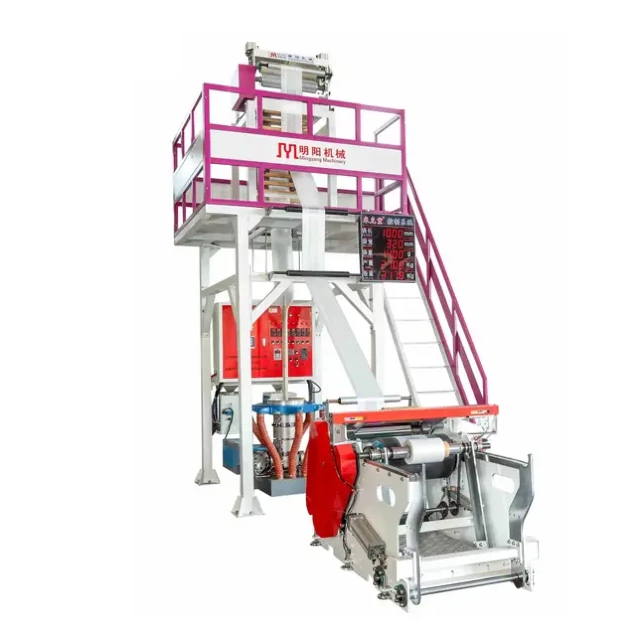
To further illustrate the differences between blown film and other film production methods, here’s a comparison of key performance characteristics:
Feature | Blown Film | Cast Film | Blow Molding |
Strength | Higher biaxial strength | Moderate uniaxial strength | High internal pressure resistance |
Clarity | Varies | Often better | Not typically used for clarity |
Speed | Lower | Higher | Moderate |
Film Thickness | Customizable | Uniform thickness | Varies with mold size |
Blown film machines offer several advantages for film packaging, which is one of the most common applications for this technology. Here’s why blown film extrusion is often the best choice for producing packaging films:
One of the major benefits of blown film machines is their versatility. These machines can produce a wide range of films with different properties, depending on the materials used and the specific settings of the extrusion process. For example, films can be produced with varying thicknesses, strengths, barrier properties, and flexibility, making them suitable for a broad range of packaging applications.
Whether you need films for food packaging, medical packaging, or industrial applications, a blown film machine can meet your requirements with precision and efficiency.
With a blown film machine, manufacturers have full control over the properties of the final film. The extrusion and inflation process allows for precise adjustments to the film’s thickness, strength, and other mechanical properties. This level of control ensures that the films meet the specific needs of the application, whether it’s high strength, UV resistance, or moisture barrier properties.
Blown film machines are used to produce a wide variety of film products across different industries. Here are some of the most common applications for blown film machines:
Shopping Bags
Blown film machines are widely used in the production of plastic shopping bags, which are essential for retail and consumer packaging. These bags are made from strong, flexible films that are capable of carrying goods safely and efficiently. The ability to control film thickness and strength makes blown film machines ideal for producing high-quality shopping bags.
Mulch Film
In the agricultural sector, blown film machines are used to produce mulch films that help regulate temperature and moisture in soil. Mulch films improve crop yields by providing an optimal environment for plant growth. The films are strong, flexible, and UV-resistant, ensuring they last through harsh environmental conditions.
Protective Sheeting
Another important application of blown film machines is the production of protective sheeting for construction, manufacturing, and other industries. These films are used to cover surfaces, protecting them from dust, dirt, moisture, and other environmental factors. The durability and flexibility of blown films make them an ideal choice for protective sheeting.
In conclusion, blown film machines are the ideal solution for producing high-quality, durable films for a wide range of applications. While cast film extrusion and blow molding machines offer unique advantages for specific applications, Mingyang's blown film machines provide the versatility, strength, and customization required by industries that rely on high-performance plastic films. Whether you're producing packaging films, agricultural films, or industrial sheeting, blown film machines remain the most efficient and reliable choice.
If you're looking for a blown film machine that delivers exceptional performance, energy efficiency, and ease of maintenance, Mingyang Packaging Machinery offers the perfect solution for your needs. Contact us today to learn more about how our blown film machines can help enhance your production line.
What types of films can be produced by a blown film machine?
A blown film machine can produce a variety of films for different applications, including packaging films, agricultural films, and industrial sheeting. These films can be customized based on thickness, strength, and other properties.
How does a blown film machine create biaxial strength?
The blown film machine inflates the molten plastic, stretching it in two directions (biaxial orientation). This process increases the film’s strength, making it more resistant to tears and punctures.
What is the difference between blown film and cast film?
Blown film produces stronger, biaxially oriented films, while cast film is uniaxially oriented and typically offers better clarity but lower strength.
Why is blown film extrusion the preferred choice for packaging?
Blown film extrusion offers versatility, allowing manufacturers to create films with specific properties such as strength, flexibility, and moisture resistance. This makes it the best choice for packaging applications across various industries.


