Views: 0 Author: Site Editor Publish Time: 2026-08-13 Origin: Site
Film converters face a brutal reality on the plant floor. Sustainability mandates force you to run higher percentages of recycled content. At the same time, volatile virgin resin markets squeeze your operating margins. You need a practical way to run scrap without producing garbage film. If you try dumping post-consumer recycled (PCR) plastics or heavy calcium carbonate (CaCO3) into a standard mono-layer line, you hit a wall. Tensile strength drops. The surface looks terrible. Heat seals fail on the bag machine. This forces plant managers into a difficult corner.
The ABA film blowing machine fixes this exact problem. It lets you bury cheap, highly contaminated recycled materials in the thick core layer. You then cap it with thin layers of virgin resin on the outside. You get the mechanical strength and glossy finish of virgin film while drastically cutting your raw material consumption. Understanding how to leverage this equipment separates profitable extrusion operations from those struggling to survive.
Material Cost Reduction: ABA configurations allow converters to utilize significant percentages of recycled material or CaCO3 in the middle layer, drastically lowering overall resin costs without sacrificing film integrity.
Optimized Capital Expenditure: Utilizing two extruders to produce a three layer co-extrusion film offers a lower initial investment, a simpler structure, and easier operation compared to traditional ABC (three-extruder) setups.
The "Stronger Film" Paradox: The synergistic structural dynamics of co-extrusion mean an ABA film can often achieve higher tear and puncture resistance than a thicker mono-layer film blended with the same amount of recycled content.
Uncompromised Quality: The virgin 'A' layers ensure a glossy surface finish, reliable printability, and robust heat-sealing performance, effectively masking the impurities of the recycled 'B' layer.
Application Versatility: Ideal for high-volume, cost-sensitive products like garbage bags, shopping bags, courier envelopes, and agricultural films.
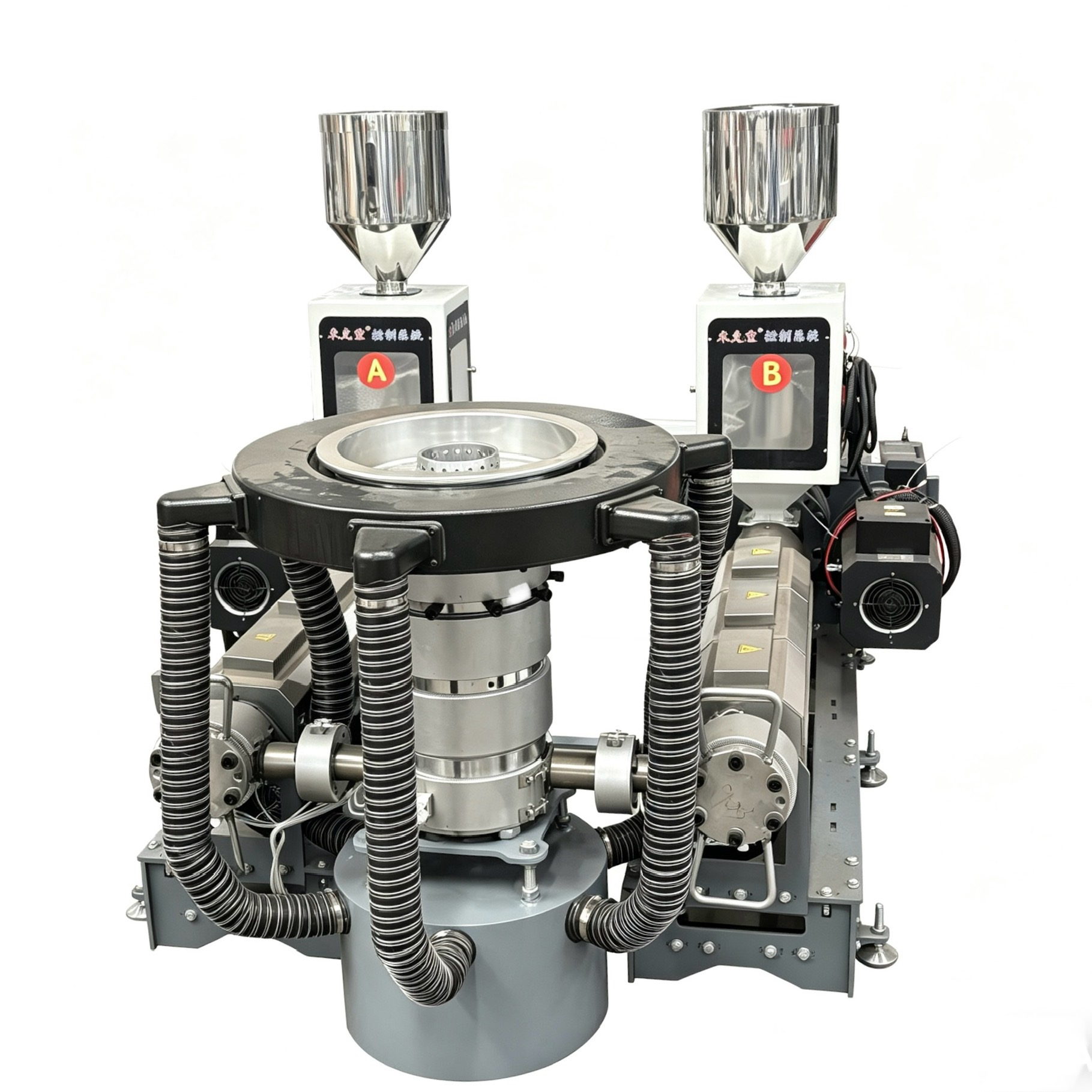
The mechanical foundation relies on two extruders feeding a single specialized die head. This system creates three distinct layers from two material sources. The primary extruder handles the core 'B' layer. The secondary extruder processes the outer 'A' layers. The die head splits the melt flow from the secondary extruder, routing it to form both the inner and outer skins of the film bubble.
Operators typically run layer ratios like 20/60/20 or 10/80/10. The core 'B' layer absorbs the bulk of the material volume. You pack this thick middle layer with PCR pellets, industrial scrap, or heavy CaCO3 compounds. The thin 'A' layers require minimal virgin resin. This precise distribution of polymers ensures structural integrity while heavily diluting raw material expenses.
Layer Ratio (A/B/A) | Core Thickness | Virgin Resin Usage | Ideal Application |
|---|---|---|---|
30 / 40 / 30 | Moderate | High | Premium retail shopping bags requiring high gloss. |
20 / 60 / 20 | Thick | Medium | Standard courier envelopes and shipping sacks. |
10 / 80 / 10 | Maximum | Low | Heavy-duty garbage bags and agricultural mulch films. |
The die head dictates the success of the entire operation. It must ensure uniform flow velocities across all three layers. Poor die design leads to layer mixing or interfacial instability. This causes visual defects, gauge bands, and weak spots in the film. Advanced spiral mandrel dies maintain precise thickness distribution. They prevent the highly viscous recycled core from breaching the thin virgin skin layers during extrusion.
Screw design for the 'B' extruder requires specific geometry. It must handle abrasive materials and inconsistent recycled pellets without degrading melt quality. Engineers utilize barrier flights and specialized Maddock mixing sections. These designs ensure a homogeneous melt even when processing heavily contaminated feeds. The screw must generate sufficient shear to melt the polymer without overheating the sensitive recycled compounds. Proper thermal management prevents polymer chain degradation before the melt reaches the die lip.
Recycled resins often contain un-melted particles, gels, paper dust, and discoloration. Processing these materials in a single layer exposes these flaws directly on the film surface. The outer 'A' layers of an ABA setup encapsulate this recycled core entirely. Virgin polyethylene forms a smooth, continuous barrier over the imperfections. This encapsulation prevents gels from creating stress concentrators on the surface, which normally lead to web tears.
Maintaining surface gloss is non-negotiable for downstream processing. A smooth virgin surface allows for consistent corona treatment. This treatment increases the surface tension (dyne level) of the film, preparing it for high-quality flexographic printing. Inks adhere poorly to the rough, inconsistent surfaces typical of high-recycled-content mono-layer films. The ABA structure guarantees reliable printability and strong visual appeal on the retail shelf.
The physics of a three layer co-extrusion film differ significantly from mono-layer blends. When you mix recycled material into a single layer, the impurities disrupt the polymer matrix. This creates microscopic weak points. Under stress, the film tears easily. In an ABA structure, the virgin outer layers act as a structural skin. Think of it like the steel flanges on an I-beam. They provide the necessary elasticity and tensile strength.
This multi-layer approach compensates for the reduced mechanical properties of the recycled core. The outer skins absorb initial impact forces during dart drop tests and resist puncture. Even with a highly filled, brittle core, the flexible outer layers hold the structure together. This dynamic explains why co-extruded films yield a stronger plastic web at a lower cost compared to mono-layer alternatives of the exact same micron thickness.
Basic packaging requires specific success criteria. The film must hold weight, resist tearing in the machine direction (MD), and seal reliably. A standard PE film blowing machine struggles to meet these criteria when processing high levels of recycled content. Blending virgin and recycled resins in a single layer leads to a linear degradation of film quality. Every percentage increase in recycled content directly reduces the film's mechanical strength.
This limitation restricts recycled content to low percentages before catastrophic failure occurs. Operators often max out at 15-20% recycled material in mono-layer setups. Pushing beyond this threshold results in brittle film, a bouncing frost line, frequent web breaks, and poor heat seals. The mono-layer configuration simply cannot hide the physical shortcomings of degraded polymer chains.
Equipment footprint and energy consumption vary heavily between configurations. An ABC machine utilizes three separate extruders. This requires more floor space, higher electrical draw, three separate gearboxes, and complex maintenance schedules. ABA machines use only two extruders. This reduces the initial capital investment significantly. You consume less power and require fewer spare parts in the warehouse.
ABC machines offer total layer independence. They are essential for complex barrier films requiring distinct polymers like EVOH, Nylon, or tie-layers in the core. However, for standard packaging, this complexity is a waste of money. ABA machines provide the exact structural benefits needed for recycled integration. You achieve the necessary three-layer physical properties at a lower cost and with much simpler operator training.
Feature | Mono-Layer Extrusion | ABA Co-Extrusion | ABC Co-Extrusion |
|---|---|---|---|
Extruder Count | 1 | 2 | 3 |
Max Recycled Content | 15% - 20% | 50% - 80% (Core) | 50% - 80% (Core) |
Initial Investment | Low | Medium | High |
Operational Complexity | Simple | Moderate | High |
Maintenance Overhead | Low | Medium | High (3 motors, 3 drives) |
Primary Application | Basic virgin films | Cost-sensitive recycled bags | Complex barrier packaging |
Realistic formulation scenarios depend entirely on the end-use application. Retail shopping bags require a balance of strength and aesthetics. For these, operators typically run 20-30% post-consumer recycled (PCR) plastics in the core layer. This maintains a premium feel while reducing costs. Heavy-duty garbage bags have different requirements. Here, you can push up to 70% recycled content or high-load CaCO3 in the middle layer.
Integrating CaCO3 offers unique thermal advantages for recycled film production. Calcium carbonate conducts heat better than polyethylene. When packed into the core layer, it pulls heat out of the bubble faster. Faster cooling allows operators to increase nip roller speeds. This thermal property actively increases overall machine output, compounding the material cost savings with higher production efficiency.
Advanced gravimetric blending technology is mandatory for high-efficiency operations. These loss-in-weight dosing systems weigh materials continuously before feeding them into the extruder throat. They ensure precise A/B/A ratios regardless of changes in bulk density. Recycled pellets often vary wildly in size and weight. Volumetric feeders cannot account for these variations, leading to inconsistent layer distribution and wasted virgin resin.
Gravimetric systems optimize the extrusion process. They prevent virgin material waste by strictly controlling the 'A' layer thickness down to the micron. If the core layer fluctuates, the system automatically adjusts screw speeds to maintain the target ratio. This precision maintains consistent film strength despite highly variable recycled feeds. It eliminates the need for operators to manually over-compensate with expensive virgin resin just to keep the bubble stable.
Evaluating the payback period of an ABA machine requires a structured framework. You must calculate the delta between virgin LLDPE/HDPE prices and recycled pellet or CaCO3 prices. Track these figures over a standard production year. Determine your annual tonnage and calculate the exact percentage of material shifted from virgin to recycled.
For example, shifting 50% of your total resin volume to a core layer compound that costs half the price of virgin resin yields massive monthly savings. Factor in the reduced energy consumption compared to an ABC line. Subtract the initial capital expenditure. In high-volume operations producing garbage bags or courier envelopes, the material savings alone often cover the cost of the machine within 12 to 18 months.
Processing abrasive materials introduces severe wear and tear on machinery. Calcium carbonate and contaminated PCR act like sandpaper inside the barrel. Standard steel components degrade rapidly under these conditions. This wear increases the clearance between the screw flights and the barrel wall. Increased clearance reduces pumping efficiency, lowers output, and causes severe melt temperature fluctuations.
You must specify bimetallic screws and barrels for the 'B' extruder. Manufacturers coat these components with tungsten carbide or similar hardened alloys. This mitigation strategy prevents premature wear. It maintains long-term extrusion efficiency and protects your investment. Failing to upgrade the metallurgy of the core extruder guarantees costly downtime and frequent screw rebuilding.
Managing melt temperatures and pressures becomes highly complex when running variable recycled streams. Recycled materials often have inconsistent melt flow indices (MFI). Operators must monitor pressure transducers closely. Sudden spikes in die pressure indicate blockages or degraded material. The crew must possess the expertise to adjust PID temperature profiles dynamically to prevent web breaks.
Continuous melt filtration is required. You need dual-piston screen changers on the 'B' extruder. These devices filter out un-melted paper, aluminum, or degraded polymers from the PCR stream. A continuous screen changer allows operators to swap clogged filters without stopping the extrusion line. This prevents die blockages, reduces machine downtime, and keeps production yields high.
Assess a manufacturer's capability to customize screw geometries. Do not accept off-the-shelf screw designs for high-recycled-content processing. The vendor must analyze your specific material blends. They should design the 'B' screw with appropriate mixing zones and shear rates to handle your exact PCR or CaCO3 ratios. Ask for engineering drawings or simulation data proving the screw's melting capacity before signing a purchase order.
The quality of the co-extrusion die is the most critical component to inspect during vendor evaluation. A poorly machined die guarantees uneven layer distribution. Request gauge variation data from previous installations. Look for tolerances within 2 Sigma. The die must maintain strict separation of the layers until they exit the lip. Surface plating quality inside the die channels also prevents polymer hang-up and degradation.
Evaluate the cooling infrastructure. Advanced dual-lip air rings stabilize the bubble immediately upon exiting the die. Internal bubble cooling (IBC) systems are essential for high output. IBC uses exhaust blowers and ultrasonic sensors to exchange hot air inside the bubble with chilled air. This maximizes cooling efficiency and stabilizes the web. A robust cooling system directly dictates the maximum line speed you can achieve.
Partnering with a reliable blown film machine manufacturer ensures long-term operational success. Look for vendors that integrate advanced profile control technologies. Automated gauge control systems measure film thickness and adjust air ring localized cooling to correct deviations automatically. This reduces reliance on manual operator adjustments and cuts down on scrap rolls.
Investigate their after-sales infrastructure. You need rapid tooling replacement and guaranteed spare parts availability. Remote diagnostic support is a necessity. The manufacturer should be able to log into your PLC remotely to troubleshoot drive faults or temperature anomalies. This capability minimizes downtime and keeps your production schedule intact when local technicians are unavailable.
Request comprehensive material trials with your specific recycled resin and CaCO3 blends before committing to a machine purchase.
Audit the die-head manufacturing capabilities of potential vendors to ensure precise layer distribution and tight gauge tolerances.
Specify bimetallic screws and continuous dual-piston screen changers for the core extruder to handle abrasive and contaminated materials.
Install gravimetric dosing systems to strictly control material ratios and prevent the waste of expensive virgin resins.
A: The maximum percentage depends entirely on material quality and the end application. For higher-end retail packaging, operators typically run 20-30% recycled material in the core. For heavy-duty applications like garbage bags, you can push the core layer up to 50-80% recycled content or CaCO3 without catastrophic failure.
A: Yes. ABA machines are highly versatile. However, processing different resins requires specific die gaps or interchangeable die inserts. HDPE requires a different blow-up ratio and neck height compared to LDPE. Operators must adjust the die lip and cooling parameters to accommodate the specific rheology of the chosen polymer.
A: An ABA machine eliminates the need for a third extruder. This reduction lowers initial capital costs. It also significantly decreases ongoing energy consumption, requires less floor space, and reduces mechanical maintenance. You achieve a three layer co-extrusion film structure with the operational overhead of a two-extruder system.
A: Yes. Calcium carbonate is an opaque mineral. Adding it to the core layer will make the resulting film opaque or milky. This makes the formulation highly suitable for garbage bags, courier bags, or agricultural mulch films. It is not suitable for applications requiring high-clarity packaging.
A: Mono-layer films with high recycled content often suffer from weak, inconsistent heat seals due to impurities. The ABA configuration places pure, virgin polyethylene on the outer 'A' layers. This provides a clean, consistent polymer surface that melts uniformly during the heat-sealing process, ensuring robust and reliable closures.
A: ABA films are ideal for high-volume, cost-sensitive products that do not require complex gas barriers. The most common applications include T-shirt shopping bags, heavy-duty garbage bags, industrial shipping sacks, opaque courier envelopes, and various agricultural films where strength and low cost are prioritized.